Loading game
Preparing player
Loading game
Ready to play
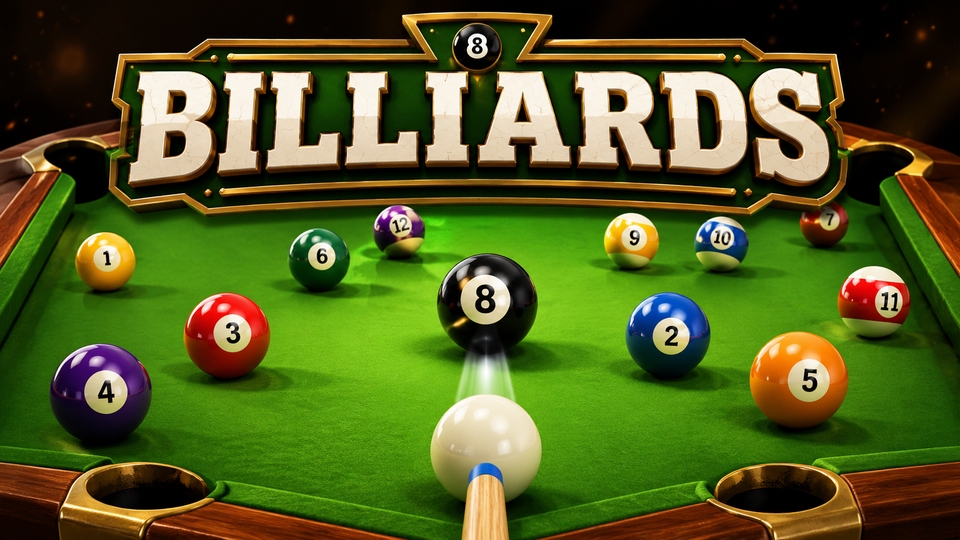
Play Billiards by aiming precise shots, controlling cue-ball power and spin, clearing your solids or stripes, and pocketing the 8 ball to win.
Billiards is an 8-ball-style pool game built around accurate aiming, controlled shot power, and smart cue-ball positioning. You use the white cue ball to pocket either solids or stripes, clear your assigned group, and then sink the 8 ball to win. The challenge is not simply making the current shot; a strong turn also leaves the cue ball in a useful position for the next one.
The table contains six pockets and a set of numbered balls divided into solids and stripes, along with the black 8 ball. During play, you use the cue ball to strike the other balls and send your assigned group into the pockets.
Once your group has been determined, your objective is to pocket all of those balls before attempting the 8 ball. Pocketing the 8 ball too early causes you to lose, so clearing the table in the correct order matters as much as shot accuracy.
Billiards also lets you control the spin placed on the cue ball. This adds another layer of strategy because you can influence where the white ball travels after contacting your target. Instead of thinking about only one pocket at a time, you can use spin and power to prepare a better angle for your following shot.
Planning becomes increasingly important as the table clears. Early in the game there are many possible targets, but later shots often require more precise angles because fewer balls remain available.
The game specifically allows the cue ball to be repositioned when directional arrows appear around it. This occurs during the break or after the opponent commits a foul.
Spin changes what happens to the cue ball after impact. Normally, striking near the center produces a more straightforward response. Moving the contact point on the cue-ball control lets you modify that movement.
Apply backspin by moving the contact point toward the bottom of the cue-ball icon. After hitting another ball, the cue ball can pull backward instead of continuing forward. This can help prevent the white ball from traveling too far beyond your intended position.
The real value of spin becomes clear when you think one shot ahead. Pocketing a ball is useful, but pocketing it while leaving the cue ball with a clean angle toward your next target is much stronger.
Do not add spin automatically to every attempt. A simple center-ball shot is often easier to predict. Use spin when you have a specific reason to change the cue ball's path after contact.
A scratch can give your opponent a major positional advantage. In this version of Billiards, a scratch can occur if you pocket the cue ball, fail to make contact with another ball, or strike the opponent's group first. After a scratch, the opponent can reposition the cue ball on the table.
This makes cue-ball control especially important near pockets. A powerful shot may sink your target successfully while also sending the cue ball into a pocket, turning a good-looking attempt into a foul.
The break also has its own consequence. According to the game's rules, scratching during the break does not automatically end the game; instead, the opponent receives the opportunity to break.
Before shooting, consider both the object ball and the cue ball. The object ball needs a path toward the pocket, but the cue ball also needs somewhere useful to finish. This approach can turn isolated successful shots into longer sequences.
Harder shots create more movement around the table and can make the cue ball difficult to predict. When the target is close to a pocket, a controlled shot may give you better positioning than maximum power.
Do not wait until a ball has been pocketed to decide what comes next. Before taking the current shot, identify another ball from your group that you may want to attack afterward. Then try to leave the cue ball with an angle toward it.
The cue ball can scratch just as easily as your target can be pocketed. When your shot sends the white ball across the middle of the table, check whether its projected path brings it dangerously close to a side pocket.
If one of your balls is against a cushion or surrounded by other balls, forcing an immediate attempt may waste your turn. Clear easier targets first when doing so can create a better angle toward the difficult ball later.
If you enjoy the precision and sports-focused gameplay of Billiards, you can also explore these games on YaloGames:
For another game where carefully judging an angle matters, start with Golf Puzzle. If you would rather switch to faster competitive sports gameplay, try Arcade Tennis or Basketball Stars.
Your goal is to pocket your assigned group of solids or stripes and then sink the 8 ball before your opponent completes the same objective.
Move the mouse to aim, then click and drag to set the strength of the shot. Release the mouse button to strike the cue ball.
Use the cue-ball icon at the top of the game interface and move the contact point in the direction needed. Changing the contact point alters how the cue ball behaves after hitting another ball.
In this version, pocketing the cue ball, failing to contact another ball, or striking the opponent's ball first can count as a scratch. The opponent can then reposition the cue ball.
The 8 ball should be pocketed only after all balls from your assigned group have been cleared. Sinking it too early causes you to lose the game.
Billiards rewards more than simply finding a ball that can reach a pocket. Shot strength, cue-ball spin, collision angles, and the position you leave for your next attempt all influence the outcome. Start by learning to control power consistently, then begin planning multiple shots ahead. Once you can pocket your solids or stripes without giving away easy scratches, finishing the table with the 8 ball becomes much more manageable.
LIVE CHAT
No messages yet. Start the conversation.
Log in to join the chat.
Login