Loading game
Preparing player
Loading game
Ready to play
2048 is a sliding number puzzle where you merge matching tiles, protect board space, and build a clear strategy to create the 2048 tile and beyond.
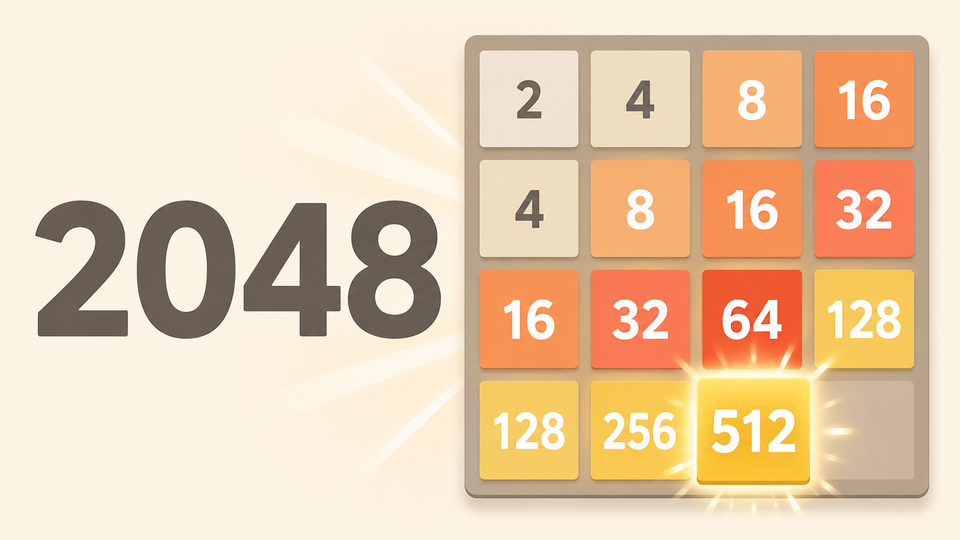
2048 is a single-player sliding number puzzle played on a compact 4×4 grid. Every move pushes all available tiles in one direction, and matching values merge when they collide. Your main objective is to combine powers of two until one tile reaches 2048 without allowing the board to become completely blocked.
The controls are simple, but the board changes after nearly every move. A new low-value tile appears, empty spaces become harder to protect, and poorly positioned numbers can prevent future combinations. Reaching the target therefore depends less on rapid movement and more on organization, planning, and restraint.
A new game begins with two numbered tiles placed on the board. These starting tiles normally display either 2 or 4. When you choose a direction, every tile slides as far as it can until it reaches the edge of the grid or another tile.
Two tiles can merge only when they have the same value. Their numbers are added together to create one larger tile:
After a valid move, another 2 or 4 usually appears in an empty square. This means every swipe or key press has a cost: even when a move creates no useful merge, it may still reduce the amount of free space available for later decisions.
The original 2048 was created by Gabriele Cirulli and released as an open-source web game in March 2014. Its source repository describes it as a project inspired indirectly by Threes and related number-merging games.
The game ends when the grid contains no empty squares and no adjacent matching tiles. Reaching 2048 counts as the central goal, but many versions allow you to continue and attempt to create 4096, 8192, or an even larger number.
A single input affects the entire grid. You are not controlling one tile independently, so always check how the move will reposition your largest number, your next matching pair, and the empty squares at the same time.
One of the most practical 2048 strategies is to keep your highest-value tile in a chosen corner. The bottom-left and bottom-right corners are common choices, but any corner can work if you remain consistent.
Suppose you choose the bottom-right corner. Your largest tile should remain there, with the next-largest values arranged beside it in descending order. A useful bottom row might look like this:
| Fourth Largest | Third Largest | Second Largest | Largest |
|---|---|---|---|
| 128 | 256 | 512 | 1024 |
This ordered chain makes future merges easier to prepare. It also stops a large tile from becoming trapped between unrelated smaller numbers in the middle of the grid.
If your largest tile is in the bottom row, try to keep that row full. A complete row prevents the corner tile from shifting when you move horizontally. It also lets you use three directions more safely while maintaining the board’s overall structure.
When your highest tile is anchored at the bottom, moving upward is risky. An upward move can pull the entire number chain away from its protected edge. Use that direction only when no safer move remains or when you have calculated how to rebuild the arrangement afterward.
Empty squares are among the most valuable resources in the 2048 puzzle. More open cells give new tiles room to appear and give existing numbers space to move into useful combinations.
A useful way to judge a move is to ask what the board will look like after the new tile appears. The immediate merge matters, but the position created for the following turn matters just as much.
Tiles merge in the direction of movement, and a newly created tile cannot normally merge again during that same move. Understanding this rule prevents incorrect expectations when several matching values share one row.
For example, consider a row containing:
2, 2, 2, empty
If you slide left, the first two tiles combine into 4, while the third 2 remains separate. The result becomes:
4, 2, empty, empty
With four matching tiles:
2, 2, 2, 2
A left move creates two separate 4 tiles:
4, 4, empty, empty
Those two 4 tiles can then merge on a later move. Recognizing these sequences helps you prepare chain reactions without accidentally breaking your number order.
Random movement may produce early merges, but it usually scatters high-value tiles across the grid. Choose a corner and treat movements away from that corner as deliberate exceptions.
A central high-value tile blocks several lanes and divides smaller numbers that need to reach one another. Moving it toward an edge becomes harder as the grid fills.
If a small tile appears between two large values, the larger pair may become impossible to combine. Keep the strongest numbers ordered rather than merging wherever space happens to appear.
Players who anchor the board at the bottom frequently lose control after repeated upward moves. Protect the anchor row and use the opposite direction only when the resulting position has been considered carefully.
A board containing many isolated numbers has few available merges. Try to build pairs in advance so newly created tiles have a clear route toward a matching value.
The open-source structure of the original game led to many themed and mechanical variations. Searchers may encounter names such as 2048 Cupcakes, Doge 2048, Cubes 2048, Minecraft 2048, 2048 Snake, and Ball Run 2048. These games borrow the number-merging idea but may replace tiles, change movement, add characters, or use larger environments.
This guide focuses on the classic 4×4 2048 game: move the entire board, combine equal numerical tiles, preserve open cells, and create the 2048 tile.
Combine matching powers of two until two 1024 tiles merge into one 2048 tile. Keeping the largest tile in a corner and arranging other high values beside it improves your chances.
It uses addition and powers of two, but its main challenge is spatial planning. Players must organize the grid, predict movement, and preserve future merge opportunities.
Yes. The classic game allows continued play after the target appears, letting you pursue higher-value tiles and a larger score.
A full grid is not automatically a loss if matching adjacent tiles can still merge. The game ends only when there are no empty spaces and no legal combinations in any direction.
Keep your largest tile fixed in one corner and maintain an ordered chain of descending values along the connected row or column. This creates a predictable path for future merges.
Winning 2048 is not simply a matter of combining every available pair. Strong play comes from controlling where those combinations happen. Protect one corner, preserve empty cells, keep your large tiles ordered, and consider how each move affects the next one. A stable board will eventually produce the 2048 tile more reliably than a sequence of quick but disconnected merges.
LIVE CHAT
No messages yet. Start the conversation.
Log in to join the chat.
Login