Loading game
Preparing player
Loading game
Ready to play
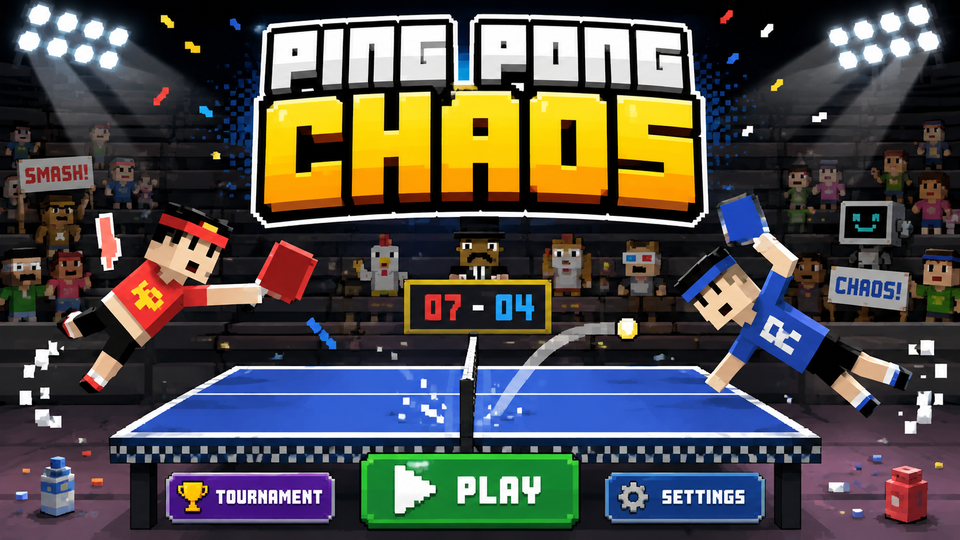
Play Ping Pong Chaos, jump left or right, return unpredictable shots, add spin, avoid the center table, and score five points before your opponent.
Ping Pong Chaos is a physics-based table tennis game where each player controls a floppy character using only two movement buttons. Instead of moving normally around the table, you jump left or right and try to collide with the ball at the correct angle. Send the ball onto your opponent's side, avoid costly mistakes around the center table, and become the first player to score five points.
The game was created by New Eich Games and originally released in 2017. You can challenge the computer, compete against a friend locally, or organize tournament-style matches. The combination of simple controls and unpredictable physics makes positioning and timing more important than traditional ping-pong paddle movement.
Each side controls one character positioned beside the table. There are no traditional left, right, jump, and swing controls. Instead, your two buttons make the character leap in different directions.
Your character automatically interacts with the ball when the body or paddle reaches it. That means the main challenge is getting into the right position before the ball arrives. Jump too early and you may fall away from the return. Jump too late and the ball can land before you make contact.
A match is won by the first player to reach five points. The game also changes conditions with different maps, balls, and effects, so the same movement timing does not always produce an identical rally.
The two-button design is deliberately difficult to control. Rather than making precise walking adjustments, you often need to predict the ball's future position and start moving before it arrives.
| Player | Control | Action |
|---|---|---|
| Player 1 | W | Jump left |
| Player 1 | E | Jump right |
| Player 2 | I | Jump left |
| Player 2 | O | Jump right |
After making contact with the ball, continue holding the jump button to add spin. This gives you another way to influence the return instead of relying only on the initial collision angle.
Pressing movement buttons repeatedly does not necessarily help. Each jump changes your character's body angle and momentum, so unnecessary inputs can move the paddle away from the ball instead of toward it.
Watch the height and direction of the incoming shot first. If the ball is still far away, an early jump may leave you lying in the wrong position by the time it reaches your side. Smaller, better-timed movements give you more control over the eventual contact.
The same idea applies after your return. Recovering into a useful position is important because your opponent may immediately send the ball back toward an exposed part of your side.
Ping Pong Chaos includes a simple spin mechanic. After hitting the ball, holding the movement button can alter its movement and make the return less straightforward for the opponent.
Spin works best when you already have solid contact. If your character barely reaches the ball, concentrating on the return itself is more important than trying to create a complicated trajectory.
Once your basic timing becomes reliable, experiment with holding the button after different contact angles. The goal is to produce returns that are harder for your opponent to predict and reach.
The center of the arena is not simply another surface. CrazyGames documents a penalty for touching the referee's table: doing so gives your opponent a point.
This matters when you aggressively jump toward a short ball. Reaching the ball may appear worthwhile, but continuing too far toward the center can turn a successful return into a scoring mistake.
Approach the table with enough momentum to reach the shot, but avoid unnecessary forward movement after contact.
Solo play lets you face a computer-controlled opponent while learning how the unusual movement system behaves. It is useful for understanding jump distance, contact timing, and spin before competing against another person.
Two people can play on the same keyboard. Player 1 uses W and E, while Player 2 uses I and O, so both sides can control their characters independently during the same rally.
Ping Pong Chaos also includes tournament play. The official mobile description documents tournaments for up to eight friends as well as tournament games against the computer.
The game can vary matches with different environments and balls. CrazyGames notes that rounds can use changing maps, balls, and random effects, while the original game description also includes customization options and the ability to create a customization playlist.
These changes matter because physics are central to the game. When the arena or ball behaves differently, your usual jump timing may need to change as well.
Your character cannot instantly reposition. Watch the ball's trajectory and begin the correct jump early enough to meet it rather than waiting until it is directly beside you.
If the ball is heading close to your paddle, a large movement may cause you to miss it. Avoid overcorrecting when only a small adjustment is necessary.
Do not keep moving in the same direction after striking the ball. Check where your character lands and prepare for the opponent's next return.
Hold the movement button after hitting the ball when you want to alter its trajectory. Focus on reliable contact first, then use spin to make the opponent's return more difficult.
A desperate forward jump can produce a penalty if you hit the referee's table. Judge whether the return is worth attempting before committing too much momentum toward the center.
If you enjoy the quick rallies, sports competition, and timing-based controls in Ping Pong Chaos, try these games on YaloGames:
For the closest racket-sport alternative, start with Arcade Tennis. If the chaotic ball tracking is your favorite part, Arcade Volley offers another game built around anticipating where the ball will travel.
New Eich Games developed Ping Pong Chaos. The original browser release appeared in September 2017.
Be the first player to score five points by returning the ball successfully and forcing it to land unanswered on the opponent's side.
Player 1 uses W and E to jump left and right. Player 2 uses I and O. Holding a movement button after contact can add spin to the ball.
Yes. Tournament play is supported, and the official mobile release describes tournaments with up to eight friends or against computer opponents.
Touching the referee's table gives your opponent a point, so avoid carrying too much forward momentum when chasing short returns.
Ping Pong Chaos turns a simple table tennis objective into a physics challenge where every jump changes your position and return angle. Learn to anticipate the ball instead of reacting late, use small movements when you are already close, recover after each shot, and add spin when you make clean contact. The controls may use only two buttons per player, but reaching five points consistently depends on timing those buttons well.
LIVE CHAT
No messages yet. Start the conversation.
Log in to join the chat.
Login