Loading game
Preparing player
Loading game
Ready to play
Plants vs Zombies 2 is a lane-defense strategy game where you collect Sun, place plants, use Plant Food, upgrade defenses, and stop zombie waves.
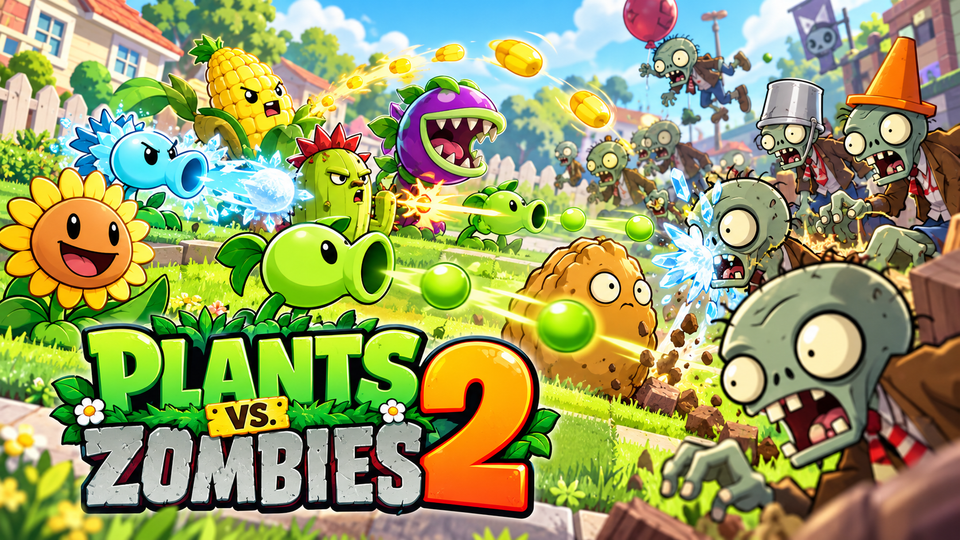
Plants vs Zombies 2 is a lane-based strategy and tower-defense game where you place plants on a grid to stop waves of zombies from crossing your lawn. Each plant has a different role: some generate Sun, some attack at range, some block advancing enemies, and others provide special effects. The sequel expands the original formula with Plant Food, plant leveling, time-travel worlds, special events, and competitive Arena challenges. EA currently describes the game as spanning 11 worlds and more than 300 levels.
Plants vs Zombies 2 was developed by PopCap Games and published by Electronic Arts. It launched worldwide on iOS on August 15, 2013, followed by its Android release in October 2013. The adventure sends the plants and zombies through different historical and futuristic settings rather than keeping every battle on the same backyard lawn.
Each level is divided into horizontal lanes. Zombies enter from the right side and move toward your house, while your plants occupy individual grid spaces between the zombies and the left edge of the lawn.
Plants require Sun to place. Sun-producing plants such as Sunflower help build your economy, while attacking and defensive plants consume that resource. The opening tutorial specifically teaches players to collect falling Sun and use Sunflowers to produce enough energy for additional plants.
The important decision is not simply which plants are strongest. You need to decide where each plant belongs, which lanes require immediate reinforcement, and how much Sun can safely be invested in economy before incoming zombies become dangerous.
The official release is designed for mobile touch controls. Tutorial messages from the game describe both dragging a seed packet onto the lawn and tapping the packet before selecting a lawn tile.
Sun controls how quickly your defense can grow. Without enough production, even a strong collection of plants becomes difficult to use because you cannot afford them when several zombies arrive together.
Sunflowers and other resource-producing plants are therefore part of your defensive plan. The challenge is deciding how many resources to dedicate to economy before adding more attacks.
Planting too few Sun producers can slow your development for the entire level. Planting too many while zombies are already advancing can leave the front of the lawn underdefended. Build enough economy to support later purchases, but continue checking how close the nearest zombies are getting.
Plant Food is one of the major additions introduced in Plants vs Zombies 2. EA describes it as a way to supercharge plants, giving individual units much stronger temporary effects.
The exact effect depends on the plant receiving it. That makes timing important. Instead of spending Plant Food automatically whenever it becomes available, save it for situations where its enhanced attack, defense, or support effect can change the course of a difficult wave.
A strong use often comes when several dangerous zombies enter at once, one lane begins collapsing, or a major enemy requires more damage than your normal formation can provide.
The current game includes hundreds of plants and zombies. Familiar choices such as Sunflower and Peashooter appear alongside later additions including Laser Bean and Lava Guava.
Instead of filling every available space with the same attacker, build around complementary roles. A durable defensive plant can delay enemies while ranged plants attack from behind it. Sun producers support the cost of the formation, while specialized plants can answer particular zombie abilities.
Before starting a difficult level, consider what problem each selected plant is expected to solve. A plant that performs well against ordinary zombies may not be the best answer to armored, airborne, fast-moving, or otherwise specialized enemies.
The time-travel structure is one of the sequel's defining changes. EA currently lists 11 worlds containing more than 300 levels, with settings ranging from Ancient Egypt to the Far Future and beyond. Each world can introduce its own zombies, environments, and gameplay conditions.
This prevents one fixed formation from solving every stage. A setup that performs well in one location may need to be changed when the terrain or enemy lineup changes.
Dr. Zomboss also appears as a major opponent connected to world progression, giving later stages a different challenge from ordinary lawn-defense waves.
Plants can become stronger through the Seed Packet system. EA states that Seed Packets can improve attacks, strengthen defenses, reduce planting time, and in some cases add new abilities.
When deciding what to strengthen, consider which plants you actually use. Upgrading a reliable part of several different strategies can provide more practical value than investing heavily in a plant that rarely enters your loadout.
Plant levels do not remove the need for good placement. Stronger statistics help, but an expensive upgraded plant can still be overwhelmed if it is placed in the wrong lane or receives no support.
Plants vs Zombies 2 includes more than its main Adventure progression. EA currently lists Arena competition, endless zones, mini-games, Piñata Party events, and Travel Log quests among its broader challenge systems.
In Arena, players build a plant lineup and compete by producing a higher score. Successful results provide Crowns that contribute toward league progression. This changes the objective from merely surviving a level to creating an efficient setup capable of defeating large numbers of zombies and producing points quickly.
Get enough resource generation working before expensive attackers become necessary. A stronger Sun economy gives you more options when several lanes require plants at the same time.
Check the entire lawn before spending additional Sun. A heavily fortified row cannot protect another lane that has been left nearly empty.
Plants designed to absorb pressure are most useful when they give ranged attackers additional time to fire. Avoid placing important damage plants where zombies can reach them before the rest of the formation can respond.
A normal wave may be manageable without it. Keep Plant Food available for large groups, threatening special zombies, or a lane that is close to breaking.
Worlds introduce different enemies and conditions. If one level repeatedly defeats the same formation, replace plants that are not addressing the actual threat rather than simply repeating the identical setup.
If you enjoy lane defense, zombies, and building increasingly strong defenses, try these related games on YaloGames:
Your goal is to place plants across the lawn and prevent waves of zombies from reaching the protected side of the battlefield.
Plant Food temporarily supercharges a plant and activates a stronger effect associated with that plant.
EA currently lists 11 worlds with more than 300 levels across the main time-travel adventure.
Yes. Seed Packets are used to strengthen plants, including improving attacks, defenses, planting speed, and other abilities.
Plants vs Zombies 2 was developed by PopCap Games and published by Electronic Arts. Its worldwide iOS launch took place on August 15, 2013.
Plants vs Zombies 2 expands the original lawn-defense formula by giving you more plants, stronger zombie variations, Plant Food, plant progression, and worlds with different rules. Establish enough Sun production to support your strategy, protect damage dealers with suitable defensive plants, monitor every lane, and change your loadout when a world's mechanics make your usual formation ineffective. The strongest defense is not simply the one with the most plants, but the one that answers the threats actually moving across the lawn.
LIVE CHAT
No messages yet. Start the conversation.
Log in to join the chat.
Login