Loading game
Preparing player
Loading game
Ready to play
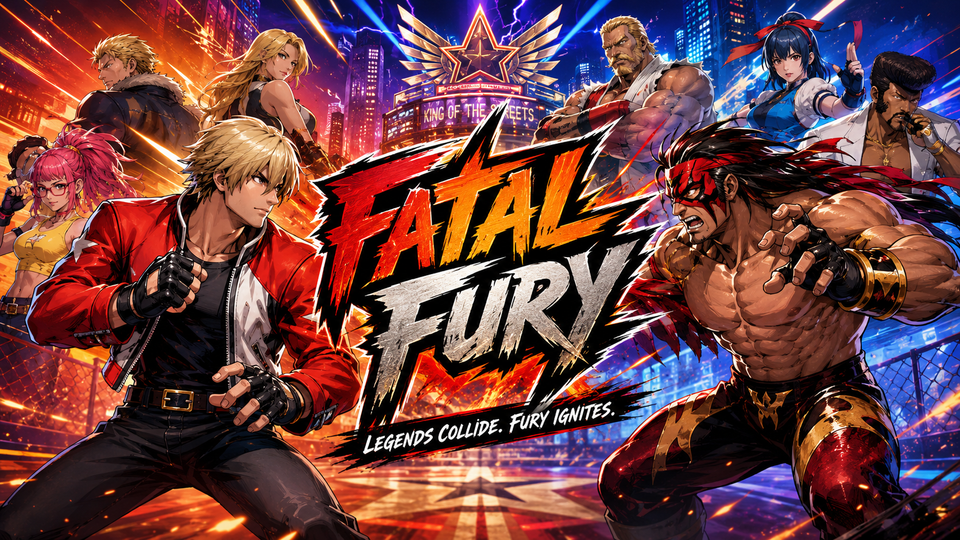
Play Fatal Fury and fight through South Town with Terry, Andy, or Joe using punches, kicks, special moves, defense, and two-plane battles against Geese.
Fatal Fury, originally released as Fatal Fury: King of Fighters, is SNK's 1991 one-on-one fighting game starring Terry Bogard, Andy Bogard, and Joe Higashi. Choose a fighter, defeat a sequence of martial artists across South Town, and survive long enough to challenge crime boss Geese Howard. Alongside punches, kicks, throws, and character-specific special moves, the original arcade game stands out for battles that can shift between foreground and background fighting planes.
Fatal Fury is a classic 2D fighting game developed and published by SNK. It launched for the Neo Geo arcade system in 1991 and became the first entry in the Fatal Fury series. It also introduced the fictional King of Fighters tournament that would later become closely associated with SNK's fighting-game universe.
The story centers on South Town and tournament organizer Geese Howard. Terry and Andy Bogard enter after Geese killed their father, Jeff Bogard. Their friend Joe Higashi also joins the tournament, creating the three playable choices available at the beginning of the original single-player game.
Each round begins with full health. Reducing the opponent's health to zero wins the round, while a match is decided by the first fighter to take two rounds. The original rules also use a round timer, so having more remaining health becomes important if time expires.
The original single-player game keeps the playable roster focused on three characters. Each has different special moves and a different approach to offense.
Terry is one of the central characters of the Fatal Fury series. His move set includes techniques such as Power Wave and Burn Knuckle, giving him ways to attack from different ranges. He enters the tournament seeking Geese Howard after the death of Jeff Bogard.
Andy is Terry's younger brother and follows the same central objective of confronting Geese. His special techniques differ from Terry's, so players need to learn different directional inputs and attack timing when switching between the brothers.
Joe is a Muay Thai fighter and friend of the Bogard brothers. His techniques include attacks such as the Hurricane Uppercut and Tiger Kick, giving him his own recognizable style within the three-character starting roster.
After choosing Terry, Andy, or Joe, the tournament sends you through a series of CPU-controlled opponents. Early opponents include Duck King, Richard Meyer, Michael Max, and Tung Fu Rue. Later fights introduce Hwa Jai, Raiden, and Billy Kane before the final encounter with Geese Howard.
The changing opponents make move recognition important. A strategy that works against a slower fighter may leave you exposed against an opponent with different reach, movement, or special attacks.
The original arcade version uses an eight-direction joystick for movement together with dedicated attack inputs. Browser versions may map these arcade inputs to different keyboard keys depending on the emulator, so the exact keyboard layout can vary.
| Arcade Input | Action |
|---|---|
| 8-way joystick | Walk forward or backward, crouch, jump, and block |
| Punch | Perform punch attacks and use certain special-move commands |
| Kick | Perform kick attacks and use certain special-move commands |
| Throw | Attempt a close-range throw |
Special attacks require directional sequences combined with an attack button. Commands depend on the selected fighter, so Terry, Andy, and Joe cannot be played effectively with exactly the same input patterns.
Holding backward while an opponent attacks lets you block. You can also crouch and guard against lower attacks by holding down and backward. Because unsuccessful special moves can leave a fighter exposed, blocking an unsafe attack can create an opportunity to respond rather than trying to interrupt every offensive sequence.
Jumping should also be used selectively. A jump can help you approach or attack from above, but an opponent who anticipates it can respond before you recover.
One of the original Fatal Fury's defining ideas is its two-plane battle system. Certain stages allow combat to take place across foreground and background lanes rather than restricting both fighters to a single horizontal line.
When fighters occupy different planes, regular interactions change. Normal attacks can become plane-crossing attacks that move toward the opponent, while special attacks are not available across separate planes. In the first Fatal Fury, CPU opponents initiate the plane changes during single-player battles, so recognizing when the fight has shifted is important before entering another command.
This mechanic distinguishes the original game from many other early 1990s 2D fighters. You are not only watching horizontal distance; you also need to recognize which fighting plane currently contains the opponent.
Each playable character has techniques activated through specific directional commands. Special moves can provide better range or different attack properties than ordinary punches and kicks, but repeatedly attempting them is risky.
If a special attack misses, its recovery can give the opponent time to counterattack. Instead of entering the command whenever you have enough distance, use special moves when the opponent's movement makes the attack likely to connect.
Terry, Andy, and Joe use different special-move commands. Pick one fighter for your first several attempts and become comfortable with their movement, normal attacks, and two or three reliable special techniques before changing characters.
Fatal Fury rewards blocking as well as offense. If an opponent is already attacking, holding back and waiting for their move to finish may produce a safer opportunity than pressing another attack immediately.
The foreground/background mechanic changes your available attacks. When the opponent shifts planes, recognize that change before attempting a special move that requires both fighters to occupy the same plane.
Throws are designed for close encounters. When an opponent allows you to stand immediately beside them, a throw can punish a defensive position differently from another standard punch or kick.
Many special techniques have recovery time. Throwing out a Power Wave or another signature attack without considering distance can let an opponent close in while your fighter is recovering.
The tournament contains fighters with different styles. Use the opening moments of a match to observe their movement rather than immediately committing to repeated jumps or special attacks.
If you enjoy the head-to-head combat in Fatal Fury, try these fighting and arena games available on YaloGames:
For another direct brawler, start with City Brawl or Tap Brawl. If you want a less traditional fighting style, Ragdoll Arena adds physics-based movement to its battles.
The original Fatal Fury was developed and published by SNK. It debuted for the Neo Geo arcade platform in 1991.
The original single-player mode lets you choose Terry Bogard, Andy Bogard, or Joe Higashi.
Geese Howard is the final opponent. Before reaching him, you must advance through the tournament and defeat the fighters protecting his position.
A match uses a best-of-three-round format. Reduce the opponent's health to zero and win two rounds before they do.
Its most recognizable mechanical difference is the use of foreground and background fighting planes on applicable stages. The plane system changes how fighters interact when they are positioned on separate lanes.
Fatal Fury combines traditional one-on-one combat with character-specific special moves, throws, defensive timing, and its distinctive two-plane battles. Choosing Terry, Andy, or Joe is only the beginning; success requires learning when to attack, when to block, and how each tournament opponent behaves. Control those fundamentals and you can push through South Town's fighters toward the final confrontation with Geese Howard.
LIVE CHAT
No messages yet. Start the conversation.
Log in to join the chat.
Login