Loading game
Preparing player
Loading game
Ready to play
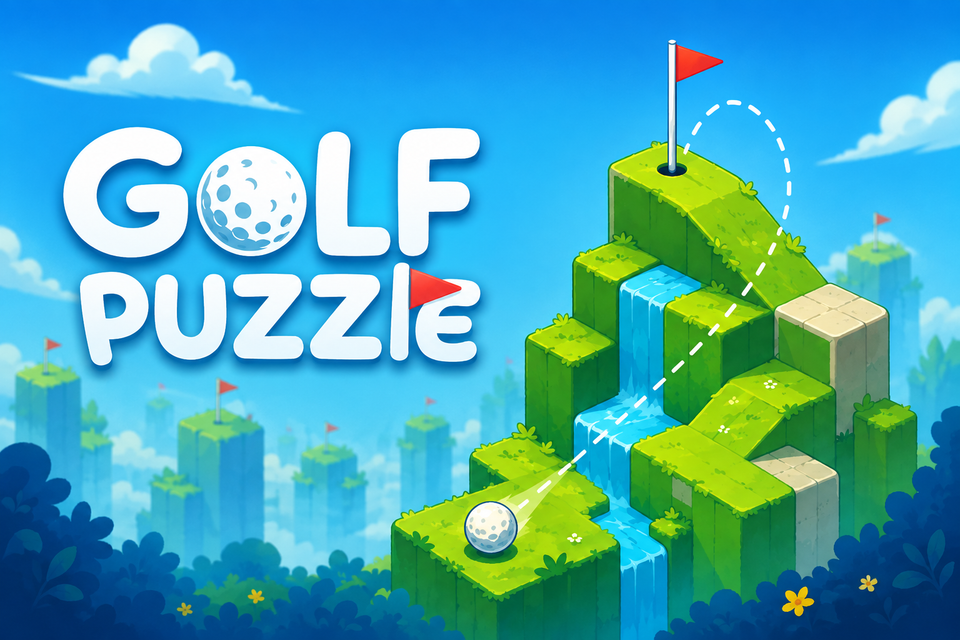
Play Golf Puzzle online for free. Use limited movement cards, plan every shot, avoid water and sand, solve tricky courses, and sink the ball in 120+ levels.
Golf Puzzle is a relaxing logic game that transforms golf into a strategic card-based challenge. Instead of controlling swing power with traditional golf mechanics, you receive a limited collection of movement cards and must use them in the correct order to guide the ball into the hole.
Every card matters. Choose a poor direction or waste an important move too early and you may find yourself stranded only a few tiles away from the goal. As you progress, slopes, sand, water, gaps, obstacles, and increasingly complex mountain layouts force you to think several moves ahead.
Your main objective in Golf Puzzle is to guide the golf ball into the hole using the limited movement cards available in each level.
Before making your first move, examine the entire course. Identify the location of the hole, dangerous terrain, useful slopes, and the cards currently available to you.
Select a movement card, choose the direction you want the ball to travel, and release to execute the move. The ball then follows the card's movement rules and reacts to the terrain underneath it.
Continue using your remaining cards until the ball reaches the hole. If you waste too many movements or place the ball in a bad position, you may need to restart and try a different sequence.
The controls are intentionally simple because Golf Puzzle is primarily about logic, planning, and understanding how each movement interacts with the course.
The card system is what makes Golf Puzzle different from traditional golf games.
Each level gives you a limited hand of cards representing specific movement distances or behaviors. Rather than freely choosing how hard to hit the ball, you must work with the movements provided.
A card that moves the ball several spaces may look powerful, but using it at the wrong moment can send you past the position needed for your next move.
Think of every card as one part of a larger solution instead of treating each shot independently.
Golf Puzzle rewards patience much more than speed.
Before using your first card, look at the complete route between the starting position and the hole.
Ask yourself where the ball needs to stop after the first move, which card can reach that location, and what options will remain afterward.
A strong opening move does more than make progress toward the hole. It also places the ball somewhere useful for your next card.
Looking only at the immediate move can make later sections impossible.
Suppose one card takes you close to the hole but leaves only cards that move too far. That move may appear successful initially, but it actually creates an unsolvable position.
Instead, consider how the current move affects the cards remaining in your hand.
The best solution often requires temporarily moving into a position that does not appear closest to the hole but creates the correct setup for the final sequence.
When a Golf Puzzle level seems difficult, try solving it backward.
Look at the tiles immediately surrounding the hole and determine where the ball needs to be before the final move.
Then ask which card can place the ball there and where you need to stand before using that card.
Continue working backward until the sequence connects with your starting position.
This approach can reveal solutions that are difficult to notice when only planning forward.
Terrain can modify how your movement cards behave.
Slopes are particularly important because gravity can help the ball travel farther than the basic card movement would suggest.
Instead of treating every hill as an obstacle, consider whether it can provide free movement toward your destination.
A correctly positioned shot onto a downhill slope may save a valuable card and make the rest of the puzzle easier to solve.
Water creates dangerous sections where careless movement can ruin an otherwise good solution.
Before playing a card near water, calculate where the ball will actually stop instead of focusing only on the direction.
Long-distance cards can be particularly dangerous when there is very little safe terrain beyond your target.
If several routes are available, the slightly longer but safer path may provide a more reliable solution.
Sand changes how the ball behaves and can interfere with your planned movement.
Landing in a sand area may reduce movement or leave the ball in a position where your remaining cards become difficult to use efficiently.
Check whether entering the sand is actually necessary before committing to the move.
Sometimes a sand tile is part of the intended route, while other times it is simply a trap designed to punish the obvious solution.
Later Golf Puzzle stages introduce gaps and more complicated terrain that require precise card selection.
Do not assume your longest movement card should automatically be used to cross every gap.
First consider where the ball will land afterward. Clearing the hazard is only useful if the resulting position allows you to continue toward the hole.
The ideal move solves both problems at once: safely crossing the gap and preparing the ball for the following card.
Some cards provide better positioning opportunities than others.
When possible, avoid spending your most flexible card during an easy opening section if a more restrictive card can achieve the same result.
Later parts of a puzzle often contain tighter spaces where flexibility becomes much more valuable.
Keeping a useful card available can give you another option when the final approach does not work exactly as expected.
Because the number of movements is limited, unnecessary shots can quickly make a level impossible.
Do not use a card merely to move closer to the hole. Each move should contribute toward the complete solution.
Before committing, ask:
Taking a few seconds to answer these questions can save several failed attempts.
One common mistake is focusing only on the area immediately surrounding the ball.
Before moving, scan the entire level from the starting position to the flag.
Look for narrow paths, elevation changes, water, sand, obstacles, and locations that appear designed as intermediate landing points.
Understanding the complete layout makes it easier to identify the route the puzzle expects you to discover.
The move that sends the ball farthest is not necessarily the best move.
In Golf Puzzle, your landing position determines which options remain available.
A shorter movement that places the ball on the correct tile can be far more valuable than a long shot that leaves you badly aligned with the hole.
Think about positioning first and raw distance second.
Traditional golf games usually challenge you to control power, angle, wind, or spin.
Golf Puzzle uses the visual theme of golf but plays much more like a spatial logic game.
The challenge is not developing perfect reflexes. It is discovering the correct sequence of predefined movements.
Players who slow down and analyze each level generally perform better than players who immediately begin experimenting with random shots.
Golf Puzzle features more than 120 handcrafted stages that gradually become more demanding.
Early levels teach you how movement cards work and provide relatively clear routes toward the hole.
Later puzzles introduce tighter layouts, additional hazards, elevation differences, and card combinations that require more careful sequencing.
Because new mechanics are introduced gradually, each completed stage prepares you for a slightly more complicated challenge.
Golf Puzzle uses peaceful mountain-inspired environments rather than traditional crowded golf courses.
As you progress, the layouts become increasingly vertical and make stronger use of slopes and elevation.
These height differences are not purely visual. They influence how you should evaluate movement and where the ball will finish after certain cards.
Study the terrain carefully whenever a new level places the hole above or below your starting position.
Do not immediately play your first card. Understand the complete course before committing to a direction.
Determine which position can reach the hole with your final card, then work backward toward the starting point.
A movement is useful only if the resulting position gives you another effective move.
Take advantage of downhill terrain when it can extend your movement without consuming another card.
Double-check your landing point before making a move near water or gaps.
Save useful movement options for later sections when possible.
The longest card is not automatically the strongest choice. Precision and setup matter more than raw movement.
If an early movement clearly makes the remaining sequence impossible, starting again can be faster than trying to rescue an unsolvable position.
A failed solution still teaches you exactly where a particular card lands. Use that knowledge to modify your next sequence.
There is no advantage in rushing through a logic puzzle. Taking time to plan often produces a faster overall solution than repeated trial and error.
When a level appears impossible, stop trying random card combinations and break the puzzle into smaller questions.
First identify the final position required to reach the hole. Then determine which remaining card can create that final movement.
Next, find the position required before that card can be used successfully.
Continue tracing the route backward until you reach your starting tile.
If several paths are possible, prioritize the route that avoids unnecessary hazards and preserves flexible cards for the final section.
Efficient card usage means making every movement serve a purpose.
A good card should either move you toward an important position, bypass a hazard, exploit terrain, or prepare the next move.
Avoid using cards simply because they are available.
Whenever two cards can reach similar positions, consider which one will be more valuable later and save the more flexible option when possible.
Slopes can change your expected movement distance, so treat them as part of the puzzle rather than ordinary tiles.
When traveling downhill, your ball may continue farther than the card's basic movement suggests.
Use that additional motion strategically to conserve cards or reach positions that would otherwise require another move.
Before committing, make sure the extra movement will not send the ball into water, sand, or another unfavorable location.
Most unsolvable situations happen because the player focuses on the current move without considering what follows.
Before selecting a card, look at what will remain afterward.
If the ball reaches a location that cannot be matched by any remaining card, choose another route even if the current move appears shorter or more direct.
Planning one or two moves beyond your immediate destination dramatically reduces these dead-end situations.
Golf Puzzle has no need for fast reflexes or complicated button combinations.
The game rewards observation, spatial reasoning, sequencing, and patience.
A player who spends twenty seconds analyzing the course can often solve the level more efficiently than someone who immediately starts clicking through cards.
That slower pace also makes Golf Puzzle different from many action-focused browser games.
Golf Puzzle combines the familiar objective of sinking a golf ball with card mechanics and spatial logic puzzles.
The controls are extremely accessible: select a card, choose a direction, and move the ball. The challenge comes entirely from determining which card should be used and when.
More than 120 handcrafted stages provide gradual progression, while slopes, sand, water, gaps, elevation, and limited movement options keep later courses from becoming repetitive.
The calm mountain presentation makes the game suitable for players who prefer thoughtful puzzle solving instead of reaction-heavy sports gameplay.
Start your first course in Golf Puzzle and see whether you can find the perfect sequence of moves. Study the terrain, examine your movement cards, plan the route, avoid dangerous hazards, and guide the ball carefully toward the flag.
Use slopes intelligently, preserve valuable cards, work backward when a solution seems impossible, and continue climbing through more than 120 increasingly challenging golf puzzles.
Think before every move and see if you can solve every hole.
If you enjoy Golf Puzzle, try these similar golf, ball, physics, sports, and precision games on YaloGames:
LIVE CHAT
No messages yet. Start the conversation.
Log in to join the chat.
Login