Loading game
Preparing player
Loading game
Ready to play
Play Merge Brainrot online for free. Drop and merge matching Brainrot characters, create rare evolutions, trigger combos, clear space, and chase your highest score.
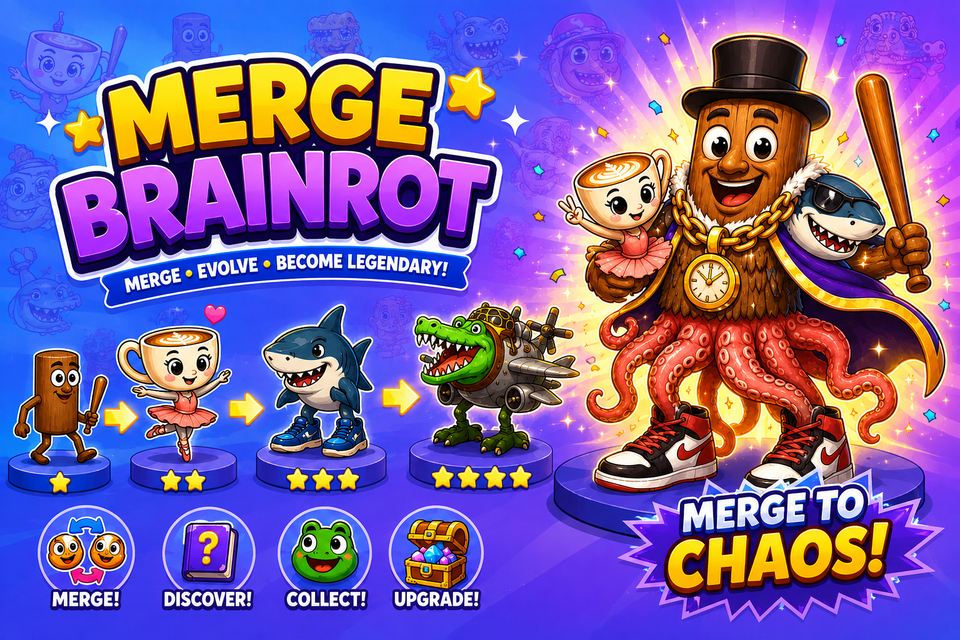
Merge Brainrot is a chaotic puzzle game where viral Brainrot characters collide, combine, and evolve into increasingly ridiculous new forms. Drop characters into the container, match two identical Brainrots, create higher-level evolutions, trigger satisfying chain reactions, and keep the board under control for as long as possible.
The basic idea is easy to understand, but achieving a high score requires careful placement. Every character occupies valuable space, and one careless drop can create a difficult stack that prevents future merges. Plan ahead, organize matching characters, and keep the top of the container clear while working toward the rarest Brainrots.
Your main objective in Merge Brainrot is to combine identical Brainrot characters and create increasingly advanced evolutions without allowing the container to overflow.
A new character appears above the play area. Move it horizontally until you find a good position, then release it into the container.
When two identical Brainrots touch, they automatically merge into the next character in the evolution chain. That new character can then be combined with another identical version to create an even higher tier.
Continue dropping, matching, and merging characters while keeping enough open space for future moves.
The core gameplay loop is simple:
The controls are intentionally simple. The real challenge comes from deciding where every Brainrot should land.
The most important rule in Merge Brainrot is that only matching characters can combine.
When two Brainrots of the same tier make contact, they fuse into a larger or higher-level character.
That new character can then be matched again if you already have another identical version somewhere inside the container.
This creates a continuous evolution system where several low-level characters can eventually become one rare Brainrot.
Your goal should not simply be making the easiest merge available.
Think about how each combination contributes toward creating the next tier.
For example, if you already have one advanced Brainrot on the left side of the container, keeping its matching evolution nearby can eventually create a powerful merge.
Organizing your board around future pairs makes progression much easier than randomly dropping characters into any available space.
Space management is the main challenge in Merge Brainrot.
Every new character takes up room, and larger Brainrots can occupy significantly more space than early pieces.
If your stack reaches too high and the play area becomes completely crowded, the run can end.
This means merging is useful for two reasons: it increases your score and compresses multiple characters into fewer pieces.
Whenever the container becomes dangerously full, prioritize merges that free space instead of chasing complicated combinations.
One of the most satisfying moments in Merge Brainrot happens when one merge immediately creates another.
Imagine dropping one character onto its match. Those two combine into a higher-tier Brainrot that lands beside another identical character. They merge again, creating an even stronger evolution.
Several combinations can happen in succession if your board is prepared correctly.
These chain reactions create large score increases while clearing valuable space at the same time.
Before releasing a character, look beyond the immediate pair.
Ask what the resulting Brainrot will become and whether that new character already has a match nearby.
A carefully planned drop can create two or three merges instead of only one.
As your board becomes more crowded, combo planning becomes one of the best ways to maintain enough room for continued progression.
Organization makes future merges much easier.
Try to keep Brainrots of similar tiers near one another instead of scattering matching characters across opposite sides of the container.
If two identical pieces become separated by several large characters, combining them later may become extremely difficult.
Grouping related tiers creates more predictable merge opportunities.
A useful strategy is reserving part of the container for lower-tier characters.
Small pieces appear more frequently, so placing them in one general area makes it easier to build combinations without interfering with your advanced Brainrots.
As those smaller pieces merge upward, gradually move the resulting characters toward the area where matching higher tiers are waiting.
You do not need to follow this strategy perfectly, but maintaining some structure helps prevent random clutter.
High-tier characters represent many previous merges.
Allowing them to become trapped beneath unrelated pieces can make reaching the next evolution much harder.
Try to keep valuable Brainrots somewhere they can still interact with future matching characters.
Leaving useful space around your largest pieces gives you more options when the matching evolution eventually appears.
Merge Brainrot uses physics, so dropped characters do not always remain exactly where they first land.
They can bounce, roll, push other pieces, and settle into unexpected positions.
Take this into account when dropping near curved surfaces or unstable stacks.
A character released directly above its target can sometimes bounce away before making proper contact.
Whenever possible, create stable landing areas instead of depending entirely on lucky physics.
The sides of the container can help control movement.
Dropping a piece near a wall limits the number of directions it can bounce and can make the final position easier to predict.
Walls can also help keep one group of Brainrots organized while leaving the central area available for larger combinations.
However, completely filling one corner with incompatible characters can create a difficult dead zone, so continue merging whenever possible.
The middle of the container is valuable because it provides the greatest number of placement options.
If you fill the entire center with large pieces too early, future characters may be forced into poor positions near the edges.
Try to maintain enough central space for important drops and late-game merges.
Flexibility becomes increasingly important when rare characters begin appearing and you need precise positioning.
A crowded board does not always mean the run is finished.
Look for immediate pairs before dropping the next character randomly.
One successful merge may create enough space for another combination, which can trigger a chain reaction and completely reorganize the container.
When space becomes limited, slow down and think carefully before every drop.
Characters may continue moving for a short period after landing.
Dropping another piece too quickly can interfere with a merge that was about to happen naturally.
Allow unstable stacks to settle before making another important move.
A fraction of a second of patience can reveal a much better placement opportunity.
Progressing through the merge chain reveals increasingly unusual Brainrot characters.
You begin with lower-tier memes and gradually transform them into more advanced creations by repeatedly combining identical pieces.
Discovering a new character provides another goal beyond simply increasing your numerical score.
Continue merging until you have seen how far the evolution chain can go.
The collection aspect gives repeated runs more purpose.
Even when you fail to beat your previous score, you may successfully create a character you had not reached before.
Learning which Brainrots evolve into which higher tiers also makes future runs easier because you can begin planning combinations earlier.
Every successful merge increases your score, with more advanced combinations generally becoming more valuable.
Long runs provide many more opportunities for high-level merges and chain reactions.
The best way to improve your score is therefore not simply dropping quickly. It is maintaining a clean board that allows the run to continue.
Survival and scoring are directly connected.
Do not release a Brainrot simply because you see an empty space. Consider what future merge that position can create.
Characters that can eventually combine should remain reasonably close together.
Look for situations where one merge creates the exact character needed for another nearby match.
When your stack becomes too high, prioritize space-clearing merges before attempting complicated combinations.
Side walls can reduce unpredictable bouncing and help organize smaller pieces.
Avoid permanently blocking the middle of the container with unrelated large characters.
Give bouncing pieces enough time to reach their final position before making another critical drop.
Vertical stacking quickly creates overflow danger. Spread your pieces enough to maintain a lower overall board height.
Avoid burying high-tier Brainrots beneath several smaller pieces that cannot merge with them.
Always consider what character will be created after the current match and where that new piece should ideally end up.
High scores come from maintaining control of the container for as long as possible.
Begin by organizing early pieces instead of dropping them randomly. Match basic characters quickly so they do not occupy unnecessary space.
As higher tiers begin appearing, keep related Brainrots near one another and preserve open areas where future matches can happen.
Try to create chain reactions because multiple merges from one drop provide both strong scoring and efficient space clearing.
Most importantly, avoid allowing one part of the board to become permanently blocked.
Chain reactions require preparation.
Suppose you already have one advanced character waiting inside the container. Instead of placing unrelated pieces around it, try building another copy nearby.
When the lower-tier pair finally merges, the resulting character can immediately collide with the one you prepared earlier.
This creates another merge without requiring a separate drop.
The more you understand the evolution chain, the easier it becomes to intentionally create these combinations.
Avoid keeping too many unmatched low-tier characters.
Because basic Brainrots appear frequently, they should usually be merged as soon as a good opportunity becomes available.
Keep your stacks relatively low and maintain open space near the top.
If the board becomes crowded, temporarily stop thinking about rare characters and focus entirely on reducing the number of pieces.
One large merge can create enough room to continue the run.
There is no single perfect layout because physics and random drops make every run different.
However, some general structure helps.
Keep lower-tier characters together, preserve space around advanced Brainrots, and avoid separating obvious matches with large unrelated pieces.
Use corners for predictable storage but avoid creating extremely tall stacks there.
Leave enough central room for emergency placements and important late-game combinations.
Early in a run, the container has enough empty space that almost any placement seems acceptable.
That changes quickly.
Random drops create scattered matching pieces, awkward gaps, and tall stacks that become difficult to repair later.
A little organization during the easy opening stage can dramatically increase how long you survive once the container becomes crowded.
Merge Brainrot is not a completely predictable grid puzzle.
Characters can roll and bounce differently depending on their size, landing position, and surrounding pieces.
This means even similar board layouts can develop differently from one run to another.
Part of mastering the game is learning how to adapt when a character lands somewhere you did not expect.
Merge Brainrot requires almost no complicated controls.
You move a character and drop it.
The difficulty comes entirely from what happens before that drop: analyzing available space, predicting physics, planning future merges, and deciding which part of the board needs attention.
This combination makes the game accessible immediately while still providing room for high-score strategies.
Merge Brainrot combines simple puzzle mechanics, physics-based stacking, viral meme characters, collection progression, chain reactions, and high-score gameplay into an easy-to-learn browser game.
The main rule can be understood immediately: combine two identical Brainrots to create something new.
The deeper challenge comes from managing limited space. Every character you drop affects where future pieces can go, and every successful merge changes the structure of the container.
As your skill improves, you begin thinking less about the current piece and more about several future evolutions at once.
Whether you want to discover rare Brainrot characters, create huge combo chains, or simply beat your previous score, every run provides another chance to organize the board more efficiently.
Start dropping characters in Merge Brainrot and build your own increasingly chaotic evolution chain. Position each Brainrot carefully, combine identical memes, create higher-tier characters, and use chain reactions to clear valuable space.
Keep your stacks low, protect advanced characters, control unpredictable bounces, and continue merging before the container becomes completely full.
Plan every drop and see how far you can climb through the Brainrot evolution chain.
If you enjoy Merge Brainrot, try these similar Brainrot, meme, collection, clicker, and progression games on YaloGames:
LIVE CHAT
No messages yet. Start the conversation.
Log in to join the chat.
Login