Loading game
Preparing player
Loading game
Ready to play
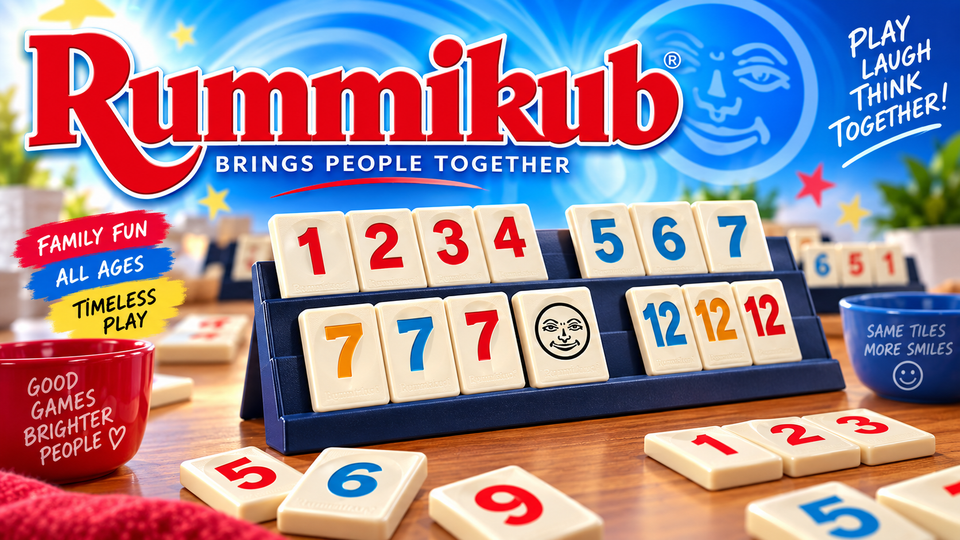
Rummikub is a tile strategy game where you build runs and groups, rearrange the shared table, use jokers wisely, and race to empty your rack first.
Rummikub is a tile-based strategy game where you arrange numbered tiles into valid groups and runs, rearrange combinations already on the table, and try to empty your rack before your opponents. The classic set contains 106 tiles numbered 1 through 13 in four colors, including two copies of every numbered tile and two jokers. A standard game supports two to four players.
The basic rules are simple, but the shared table creates much of the strategy. After making your opening meld, you can extend existing combinations, split them apart, and rebuild them into new legal sets as long as every tile on the table belongs to a valid combination when your turn ends.
Your objective is to be the first player to place every tile from your rack onto the table. Each player begins with 14 tiles, while the remaining tiles form a pool that players draw from when they cannot or choose not to make a legal play.
You cannot immediately attach tiles to combinations created by other players. First, you must complete your own initial meld using only tiles from your rack with a combined value of at least 30 points. Once that requirement has been completed, the entire table becomes available for legal rearrangement on later turns.
Every combination placed on the table must be either a group or a run. Understanding the difference is the foundation of Rummikub gameplay.
| Combination | Rule | Example |
|---|---|---|
| Group | Three or four tiles with the same number but different colors. | Red 8, Blue 8, Black 8 |
| Run | At least three consecutive numbers of the same color. | Yellow 4, Yellow 5, Yellow 6, Yellow 7 |
A group cannot contain the same color twice. A run must remain in numerical order and use only one color. Under the classic rules, 1 is treated as the lowest number rather than continuing after 13.
The ability to reorganize the table separates Rummikub from a simple matching game. A tile that appears impossible to play may become useful after an existing run is divided or a four-tile group gives up one of its tiles for another combination.
Your first move is subject to a special restriction. You must create one or more combinations worth at least 30 points using only the tiles currently on your rack. Tiles already sitting on the shared table cannot help you reach this total.
For example, a run containing 9, 10, and 11 has a value of 30 and therefore qualifies by itself. You could also place multiple smaller combinations during the same opening turn if their combined value reaches the requirement.
A joker used in the initial meld takes the value of the tile it represents. Once your opening meld has been accepted, later turns no longer need to reach 30 points.
Board manipulation is where more complex Rummikub turns become possible. After your initial meld, you may restructure existing combinations to create positions for tiles from your rack.
For example, imagine a red run of 4-5-6-7. If you have tiles that allow the table to remain legal afterward, you may be able to split that run, extend one side, or move one of its numbers into a group containing the same number in other colors.
The important restriction is the final table state. You cannot leave behind a pair of tiles when a minimum of three is required, break the color rule of a group, or leave an incomplete run. Every tile must belong to a legal combination before the turn finishes.
The two jokers are wild tiles that can stand in for a missing tile inside a valid group or run. For example, a joker could represent a blue 6 between blue 5 and blue 7, or serve as one missing color in a group of equal numbers.
A joker already on the table can also become part of later manipulation. When the rules allow you to replace it with the numbered tile it represents, the freed joker must be reused legally rather than simply stored on your rack for later. Jokers are also expensive tiles to keep at the end of a scored game because an unused joker carries a 30-point value.
Browser versions generally use direct mouse controls for moving tiles. In the documented online version, tiles can be selected with a left-click and moved onto the board by clicking and dragging. The pool can also be clicked when a draw is required.
Tiles around the middle of the 1-13 range can often connect in more directions than an end tile. For example, an 8 can potentially join 6-7, 7-9, or 9-10 arrangements once the table begins expanding. Consider this flexibility before using every adaptable tile in your opening meld.
Once table manipulation becomes available, a simple three-tile play may not be your strongest option. Check whether splitting or extending combinations lets you remove several tiles from your rack during the same turn.
A legal four-color group has more flexibility than a three-tile group because one tile can sometimes be removed and reused while the remaining three still form a valid set. These groups can create useful openings during a complicated rearrangement.
It is easy to see the first half of a combination and then discover that the remaining tiles cannot be placed legally. Before breaking an existing run or group, identify where every displaced tile will finish.
If nobody empties a rack before the pool is exhausted and no further moves are possible, remaining tiles affect scoring. Removing high-numbered tiles reduces the points left against you if the round reaches that situation.
A joker can complete a difficult combination immediately, but its flexibility may become even more valuable later when the shared table contains more runs and groups. Consider whether using it now removes enough tiles to justify giving up that flexibility.
The usual win condition is straightforward: play the final tile from your rack before everyone else. A game can also finish if the pool is empty and no player has any legal move remaining.
When scoring is used, players total the values remaining on their racks. These values count against the players who still have tiles, while the winner receives the corresponding positive total. This rewards winning while also giving players a reason to reduce expensive tiles even when they cannot empty the rack immediately.
If you enjoy Rummikub's turn-based planning, number patterns, and tabletop strategy, these related games are also listed in the YaloGames catalog.
Each player starts with 14 tiles. The remaining tiles stay face down in the pool and are drawn when a player cannot or chooses not to make a legal move.
Your initial meld must contain one or more valid groups or runs totaling at least 30 points, and all of those tiles must come from your own rack.
Yes, after completing your initial meld. You can split, extend, and recombine existing sets as long as every tile forms part of a valid group or run when your turn ends.
A joker can represent another numbered tile needed to complete a legal group or run. If retrieved from the table under the applicable rules, it must be reused as part of a legal combination.
You win by being the first player to legally place every tile from your rack onto the table.
Rummikub begins with simple number matching but becomes more strategic once runs and groups start covering the table. The strongest opportunities often come from recognizing that an existing combination can be rebuilt rather than treating it as fixed. Reach the 30-point opening requirement, preserve useful flexibility in your rack, look for legal rearrangements, and plan each manipulation through to its final table layout as you work toward playing your last tile.
LIVE CHAT
No messages yet. Start the conversation.
Log in to join the chat.
Login