Loading game
Preparing player
Loading game
Ready to play
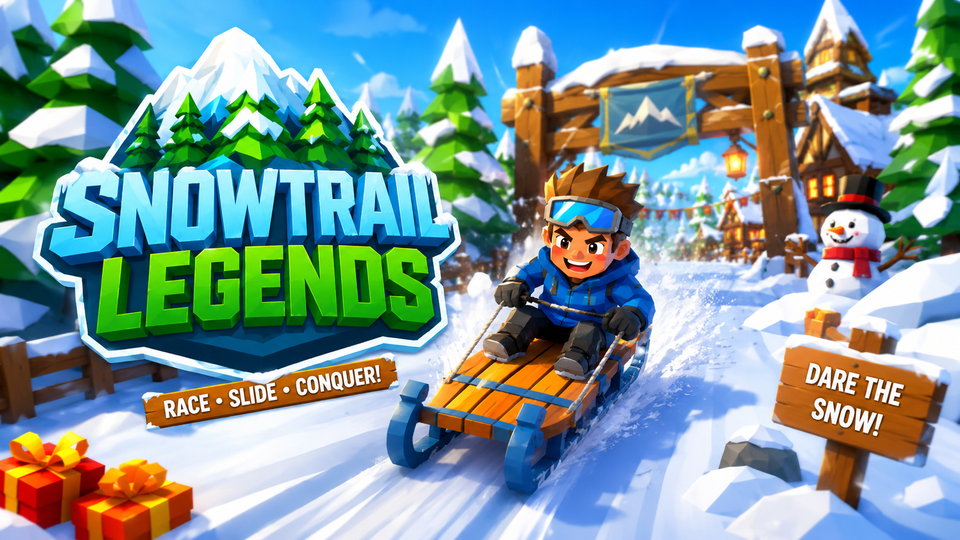
Play Snowtrail Legends online for free. Race down snowy slopes, dodge trees and rolling hazards, jump broken bridges, collect gifts, unlock sleds, and beat your distance record.
Snowtrail Legends is a fast-paced winter endless-runner game where you race down a dangerous snow-covered mountain filled with trees, rocks, gaps, broken bridges, rolling hazards, icy terrain, and unpredictable obstacles. Steer your sled or snowboard through narrow openings, jump over dangerous sections, collect gift boxes, unlock new rides, and keep moving as the mountain becomes faster and more difficult.
The controls are easy to understand, but long runs demand strong reflexes. The terrain constantly changes, meaning you cannot simply memorize one perfect route. Instead, you need to read the path ahead, choose safe lines quickly, jump at the correct moment, and avoid making sudden movements that send you directly into another obstacle.
Your main objective in Snowtrail Legends is to travel as far down the snowy mountain as possible without crashing.
Your rider automatically moves forward, so your attention remains focused on steering and jumping. Move left or right to avoid trees, rocks, holes, rolling hazards, and other dangers appearing along the course.
When a fallen tree, broken bridge, gap, or low obstacle blocks your route, use the jump control at the correct moment to clear it.
Gift boxes can appear during your run. Collect them when they are located along a reasonably safe route and use your accumulated rewards to unlock additional sleds or boards.
The farther you travel, the faster and more demanding the course becomes.
The basic gameplay loop is:
The exact secondary inputs can vary slightly between hosted versions, but the core gameplay always revolves around steering, jumping, and reacting quickly to the snowy course.
Snowtrail Legends does not give you a simple racing circuit with predictable corners.
Instead, the mountain continuously generates new terrain and hazards as you travel farther.
One moment you may be navigating between pine trees, while the next section can contain a broken bridge, deep hole, rolling obstacle, or narrow route between several hazards.
Because the environment keeps changing, survival depends more on reaction and positioning than memorization.
One of the most important Snowtrail Legends skills is looking farther down the mountain instead of staring directly at your rider.
If you notice a dangerous tree or gap early, you have more time to choose a safe route.
Waiting until the obstacle is directly in front of you forces a much sharper steering movement and increases the chance of another collision.
Train yourself to scan the upper part of the course and plan your next movement before danger reaches you.
Large left-right movements can make the sled difficult to control at high speed.
Use smaller steering corrections whenever possible.
If an obstacle is slightly to your right, move only far enough left to clear it rather than immediately crossing to the opposite side of the course.
Smooth steering keeps more of the mountain available for your next decision.
Constantly switching between left and right can create unnecessary danger.
One quick correction may avoid the first obstacle but send you directly toward a second hazard that was previously outside your path.
Choose a stable line and remain there until another obstacle gives you a clear reason to move.
Controlled positioning becomes increasingly important as your speed rises.
Fallen trees can block large sections of the snowy route.
When steering around one is difficult or impossible, prepare to jump.
Do not wait until your rider is already touching the obstacle.
Jump slightly before reaching it so you have enough height and forward movement to clear the entire trunk safely.
Broken bridge sections require accurate timing.
Approach the gap with a stable line and jump before reaching the missing section.
Avoid making unnecessary steering movements while already committed to the jump.
Your priority is reaching safe terrain on the opposite side rather than collecting nearby gifts during the crossing.
Holes in the mountain can end a run instantly if your rider drops into them.
When possible, steer around the opening early.
If the terrain forces you toward the gap and your version allows the jump to clear it, prepare your input before reaching the edge.
The safest solution usually begins several seconds before the hole itself.
Moving obstacles are more difficult than stationary trees because their future position matters more than their current one.
Do not steer toward the space where a rolling obstacle is located now.
Think about where it will be when your rider reaches that section.
Sometimes staying in your current lane and allowing the hazard to cross ahead of you is safer than making a sudden avoidance movement.
Rocks can appear in groups and create narrow paths through the snow.
Look for the largest opening rather than automatically moving toward the closest one.
A slightly longer steering adjustment toward a wide gap can be safer than forcing your sled between two tightly positioned obstacles.
Rolling snowballs add another moving threat to the mountain.
Track their direction and avoid steering toward where they are traveling.
When several hazards appear simultaneously, prioritize avoiding the moving object first because its position is less predictable.
Icy terrain can reduce how predictable your movement feels.
Avoid excessive steering while crossing slippery areas.
Make smaller corrections and begin preparing for upcoming obstacles earlier than you would on normal snow.
The faster you are moving, the more important smooth inputs become.
Ramps can launch your rider over dangerous terrain and create useful airtime.
Approach them from a stable direction so your landing remains predictable.
If a ramp already gives you enough height to clear the upcoming danger, avoid unnecessary steering in the air.
Your landing is more important than making the jump look dramatic.
A jump is not successful until your rider returns safely to the snow.
Look at the terrain where you expect to land.
A tree or rock immediately after the jump can turn a successful obstacle clearance into an instant crash.
Whenever possible, choose a launch position that gives you a clear landing zone.
Jumping is useful, but unnecessary airtime can reduce your ability to react to the next hazard.
If the path ahead is completely clear, remaining on the snow gives you more direct control.
Save jumps for obstacles, gaps, difficult terrain transitions, and situations where they provide a genuine advantage.
Gift boxes appear randomly along the mountain and contribute toward progression and unlockable rides.
Collect them whenever they fit naturally into your route.
Do not cross several dangerous lanes simply because one gift appears near a tree or hole.
Survival creates more opportunities for rewards than repeatedly ending runs while chasing one pickup.
The safest approach is to treat gifts as secondary objectives.
If a collectible appears directly along your current path or requires only a small movement, grab it.
If reaching it demands a dangerous route change at high speed, continue forward.
A longer run will naturally expose you to additional gift boxes later.
Collected rewards can unlock additional snow rides with different appearances and, in some versions, different handling characteristics.
This provides another progression goal beyond simply increasing your distance score.
Continue collecting gifts across repeated runs and expand your available collection.
If different boards or sleds provide different handling, do not automatically choose the fastest option.
A ride that feels easier to steer can produce much longer runs than one with aggressive speed that constantly causes crashes.
Experiment and choose equipment that matches your preferred playstyle.
The mountain becomes more difficult as your run continues because your speed increases and hazards arrive more quickly.
The controls do not fundamentally change.
You simply have less time to make every decision.
Stay calm and continue using smooth steering instead of responding to higher speed with random movement.
The faster your rider becomes, the farther ahead you need to look.
A movement that was safe during the first few seconds may be too late during a high-speed section.
Begin reacting as soon as you identify the upcoming hazard rather than waiting for it to become an immediate threat.
When the route is temporarily clear, staying near the middle can give you more options.
You can move either left or right depending on what appears next.
Remaining permanently near one edge can trap you when obstacles suddenly block that side of the mountain.
Use the full width of the course strategically.
Some hazard combinations create situations where one obstacle pushes you toward another.
Try to recognize these patterns early.
For example, if several trees block the right side and a rock appears near the middle, moving left early may be much safer than trying to squeeze through a narrowing gap.
The strongest route is often the one that leaves additional escape space afterward.
Avoid focusing exclusively on the next danger.
Before steering around one tree, check what is waiting behind it.
A movement that clears the first obstacle can still be a bad decision if it places you directly in front of a second one.
Thinking one additional move ahead greatly improves long-distance survival.
Snowtrail Legends is designed so you cannot depend entirely on memorizing fixed obstacle positions.
Each run demands continuous attention and adaptation.
This means strong reflexes and route reading matter more than knowing one exact level layout.
Every attempt becomes another test of how quickly you can interpret the mountain.
Crashing is part of learning Snowtrail Legends.
After each failure, identify what caused the problem.
Ask yourself whether you reacted too late, oversteered, mistimed a jump, or chased an unnecessary gift.
Correcting one repeated mistake can dramatically increase your average distance.
Experienced players often develop a natural rhythm between steering, centering, jumping, and scanning the next section.
After clearing one obstacle, stabilize your rider immediately.
Then begin reading the next section instead of continuing unnecessary movement.
This rhythm prevents one avoidance maneuver from creating the next problem.
Several hazards can appear close together and make the mountain look almost impossible.
Do not start pressing every direction.
Identify the largest safe opening and commit to it.
A deliberate route through the obstacle group is much more reliable than several emergency corrections.
Keep your attention on upcoming terrain so hazards never completely surprise you.
Move only as far as necessary to clear the current obstacle.
Do not wait until your sled is already touching a fallen tree or gap before jumping.
Collect rewards when they are safe and ignore dangerous pickups.
A central position provides more route options when new hazards appear.
Predict where rolling snowballs and other hazards will be when you reach them.
Use smaller movements when the terrain becomes slippery.
Check what is waiting beyond a gap or ramp before jumping.
Higher speed requires earlier decisions, not random button presses.
Identify the mistake and adjust your timing during the next run.
Your score improves primarily by surviving longer.
Focus first on obstacle avoidance rather than trying to collect every available reward.
Keep your steering smooth, look farther ahead, and prepare jumps before dangerous sections.
As your consistency improves, you will naturally travel farther and encounter more gifts.
Long survival should remain the foundation of your high-score strategy.
Begin each run with conservative movement.
Stay near the center whenever the course is open and move only when an obstacle requires it.
Use jumps deliberately and return to a stable line after every landing.
As your speed rises, shift your focus farther up the mountain so you have more time to react.
Avoid chasing risky gifts and prioritize open routes with enough room for another correction.
Trees are easiest to avoid when you identify them early.
Move gradually toward an open lane rather than making a sharp last-second turn.
When several trees appear together, look for the widest available gap.
Avoid squeezing between tightly spaced obstacles unless no safer route exists.
Jump timing depends on both your speed and the size of the obstacle.
Press too early and you may land before clearing the hazard.
Press too late and you may collide before the jump begins.
Use early stages to learn how far your rider travels during a normal jump, then apply that timing to larger gaps and fallen trees.
The safest way to collect more gifts is to improve your overall distance.
Longer runs naturally create more pickup opportunities.
Once you become comfortable with obstacle avoidance, begin choosing routes that combine safety with nearby gift boxes.
Avoid sacrificing an excellent run for one isolated reward.
At high speed, focus only on the information that matters most.
Identify the next safe lane, determine whether a jump is required, and avoid unnecessary movements.
Keep your inputs short and deliberate.
The less wasted motion you create, the easier it becomes to survive increasingly fast terrain.
Line up your rider before reaching the broken section.
Avoid attempting a large steering correction during the final moment.
Jump early enough to clear the missing area and continue watching the opposite side for obstacles.
Landing safely is part of the bridge crossing, so do not focus only on reaching the other side.
Watch their direction instead of steering based only on their current position.
If a snowball is moving across your route, decide whether you can pass before it or whether allowing it to cross first is safer.
Make the decision early so you do not need a dramatic correction at the final moment.
The shortest path is not always the safest path.
Choose routes with fewer obstacles and more room for future steering corrections.
When two openings appear, consider what lies beyond each one rather than only which gap is closest.
Route planning becomes increasingly important as obstacle density grows.
Identify the types of hazards that repeatedly end your longest runs.
If you crash into stationary objects, focus on looking farther ahead.
If moving hazards cause problems, practice predicting their future positions.
If gaps end your runs, work on earlier jump preparation.
Improving one weakness at a time gradually increases your average distance and eventually produces a new personal record.
Because the snowy terrain changes from run to run, memorizing one exact sequence provides limited value.
Instead, Snowtrail Legends rewards general movement skills.
You learn how to recognize safe lanes, how much steering is necessary, when a jump is required, and how early to respond at different speeds.
These skills transfer to every new run.
Snowtrail Legends demonstrates how a game can remain mechanically simple while becoming increasingly demanding.
You primarily steer and jump.
The difficulty comes from faster speed, changing terrain, moving hazards, narrow openings, and complicated obstacle combinations.
New players can understand the controls within seconds, but reaching a truly long distance requires practice and concentration.
Snowtrail Legends combines winter sports, endless-runner gameplay, snowboarding and sledding, obstacle avoidance, jumping, gift collection, unlockable rides, dynamic terrain, and high-score chasing into a fast browser arcade experience.
The basic objective is immediately understandable: keep traveling without crashing.
The deeper challenge comes from reading a constantly changing course while your speed continues increasing.
Trees, rocks, broken bridges, rolling hazards, icy sections, gaps, and moving obstacles make every run unpredictable.
Gift boxes and unlockable boards provide another progression goal, while endless distance scoring gives you a reason to immediately try again after every crash.
Whether you enjoy snowy racing, endless runners, reflex games, snowboarding, or simple high-score challenges, Snowtrail Legends provides an accessible game that becomes increasingly demanding the farther you travel.
Race into the snowy wilderness in Snowtrail Legends and see how long you can survive the mountain. Steer around pine trees and rocks, jump fallen logs and broken bridges, avoid rolling hazards, and react quickly as the terrain becomes faster and more dangerous.
Collect gift boxes along safe routes, unlock new sleds and boards, master increasingly difficult obstacle combinations, and keep pushing farther down the mountain with every attempt.
Stay focused, choose your route early, and become a true Snowtrail Legend.
If you enjoy Snowtrail Legends, try these similar snow, downhill, racing, reflex, and endless-runner games on YaloGames:
LIVE CHAT
No messages yet. Start the conversation.
Log in to join the chat.
Login