Loading game
Preparing player
Loading game
Ready to play
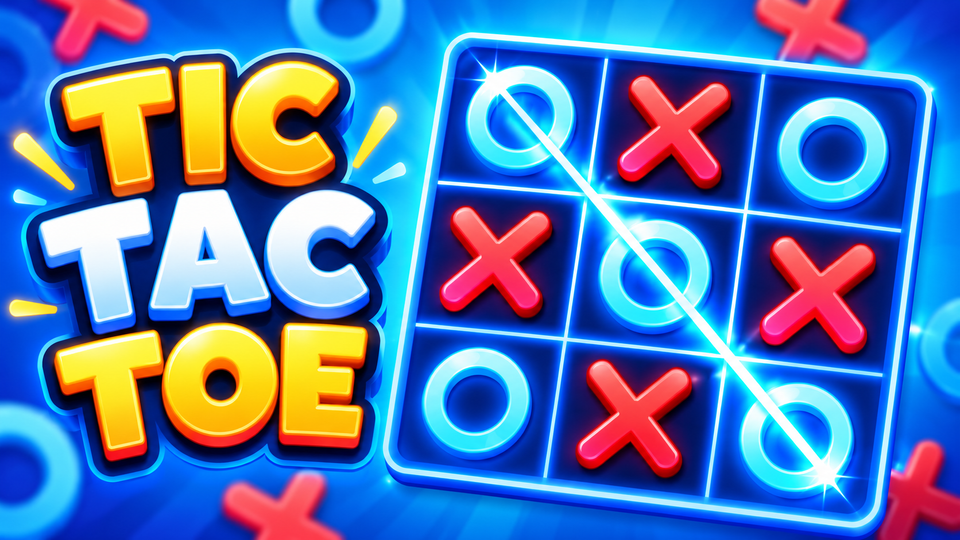
Play Tic Tac Toe on 3×3, 5×5, and 7×7 grids, build winning lines, block rival threats, create forks, and plan each X or O carefully.
Tic Tac Toe is a turn-based strategy game where two players place X and O marks on a grid and compete to complete a line before the other player does. The classic version uses a 3×3 board, while the Code This Lab browser version also offers larger 5×5 and 7×7 layouts. On the standard board, three matching marks in a horizontal, vertical, or diagonal line win the round.
Players alternate turns and place one mark in an empty square. Once a square contains X or O, it cannot be used again during that round.
The objective is to create the required line before your opponent. On the classic 3×3 board, that means connecting three marks. The current Code This Lab version also includes a 5×5 layout requiring four in a row and a 7×7 layout requiring five in a row.
A move therefore has two purposes. You are trying to improve your own position while also checking whether the opponent is close to completing a winning line. If every playable square is occupied without either side completing the required connection, the round ends without a winner.
The current Code This Lab release documents play against the computer, a friend sharing the same device, or a real opponent.
The browser version uses simple point-and-click controls, so there are no movement keys or separate action buttons to learn.
The classic board has nine squares. A player wins by occupying three squares in one continuous straight line.
There are three types of winning connection:
The center is an important square because it participates in more possible winning lines than any edge position. A center mark can contribute to a horizontal row, a vertical column, and both diagonals.
Corner squares also create useful attacking possibilities because each corner can contribute to a row, a column, and a diagonal.
For example, controlling two corners can sometimes create several potential routes through the board. Corners are also useful when responding to an opponent who opens in the center because they give you access to diagonal and outside-line combinations.
Edge squares still have strategic value, especially when they complete or block a line, but they participate in fewer possible combinations than the center or corners.
Before placing your mark, check whether your opponent already controls two squares in a line with the third square still empty. On the classic board, failing to block that position lets them win on the following turn.
This defensive check should happen before you continue a slower attacking plan. Creating your own pair of marks does not help if the opponent already has a guaranteed winning square available.
The same principle applies on larger boards. If an opponent is one mark away from completing the required four- or five-symbol connection, stopping that line takes priority unless your current move wins immediately.
A fork is a position where one mark creates two separate winning threats. Your opponent receives only one move, so they may be able to block one line but not both.
For example, your marks may be positioned so that one empty square would complete a horizontal connection while another would complete a diagonal. If both winning squares are playable after your turn, the opponent cannot cover them simultaneously.
Looking for forks is more effective than simply trying to build one obvious line from beginning to end because an obvious threat can usually be blocked immediately.
Forks work both ways. Before making a move that appears safe, check what options it gives the opponent afterward.
If their next mark could create two winning threats at once, block the setup before it develops. Preventing the fork is usually easier than trying to defend after two separate winning squares have appeared.
The larger boards create more open space and make it harder to track every developing line. The current Code This Lab version changes the winning requirement along with the board size: the 5×5 game requires four connected symbols, while the 7×7 version requires five.
On these boards, do not watch only the area where the most recent move was played. Longer horizontal, vertical, and diagonal patterns can develop several spaces away from the center.
The larger layouts also make overlapping threats more important. A mark that contributes to two possible lines can become more useful than extending one isolated connection that the opponent can easily block.
If you can complete your own line immediately, take the win instead of blocking an opponent's separate threat. Always scan your own possible connections first, then check the opponent.
The center contributes to four possible winning lines, giving it more influence than an edge square. When the center is available and fits your position, controlling it can create several future options.
Corner marks participate in both outside rows or columns and a diagonal. They are useful for creating positions where the opponent has to track multiple directions.
If every new mark extends the same row, your plan becomes easy to read. Look for moves that contribute to two potential connections so your opponent has more than one area to defend.
On 5×5 and 7×7 boards, a dangerous sequence can develop far from the previous move. Check horizontal, vertical, and diagonal patterns before placing your mark.
If you enjoy Tic Tac Toe because of its turn-based planning and board-position strategy, these YaloGames titles offer related puzzle and decision-making gameplay. The following game URLs are present in the YaloGames sitemap.
For another board-focused strategy challenge, start with Trap the Cat. If you prefer planning several moves ahead on a changing grid, 2048 provides a different kind of positional puzzle.
Place your marks so they form the required horizontal, vertical, or diagonal line before your opponent completes theirs. On the classic 3×3 board, three matching marks win.
The Code This Lab version includes 3×3, 5×5, and 7×7 boards.
The current developer listing specifies four connected marks on the 5×5 board and five on the 7×7 board.
Click an empty square with the left mouse button.
The browser version described here was created by Code This Lab.
Tic Tac Toe becomes more strategic when you stop treating each turn as an isolated move. Look for an immediate win, block direct threats, value squares that contribute to several lines, and try to create two winning possibilities at once. The classic 3×3 board rewards precise move order, while the larger 5×5 and 7×7 layouts require you to monitor longer patterns across more of the grid.
LIVE CHAT
No messages yet. Start the conversation.
Log in to join the chat.
Login